
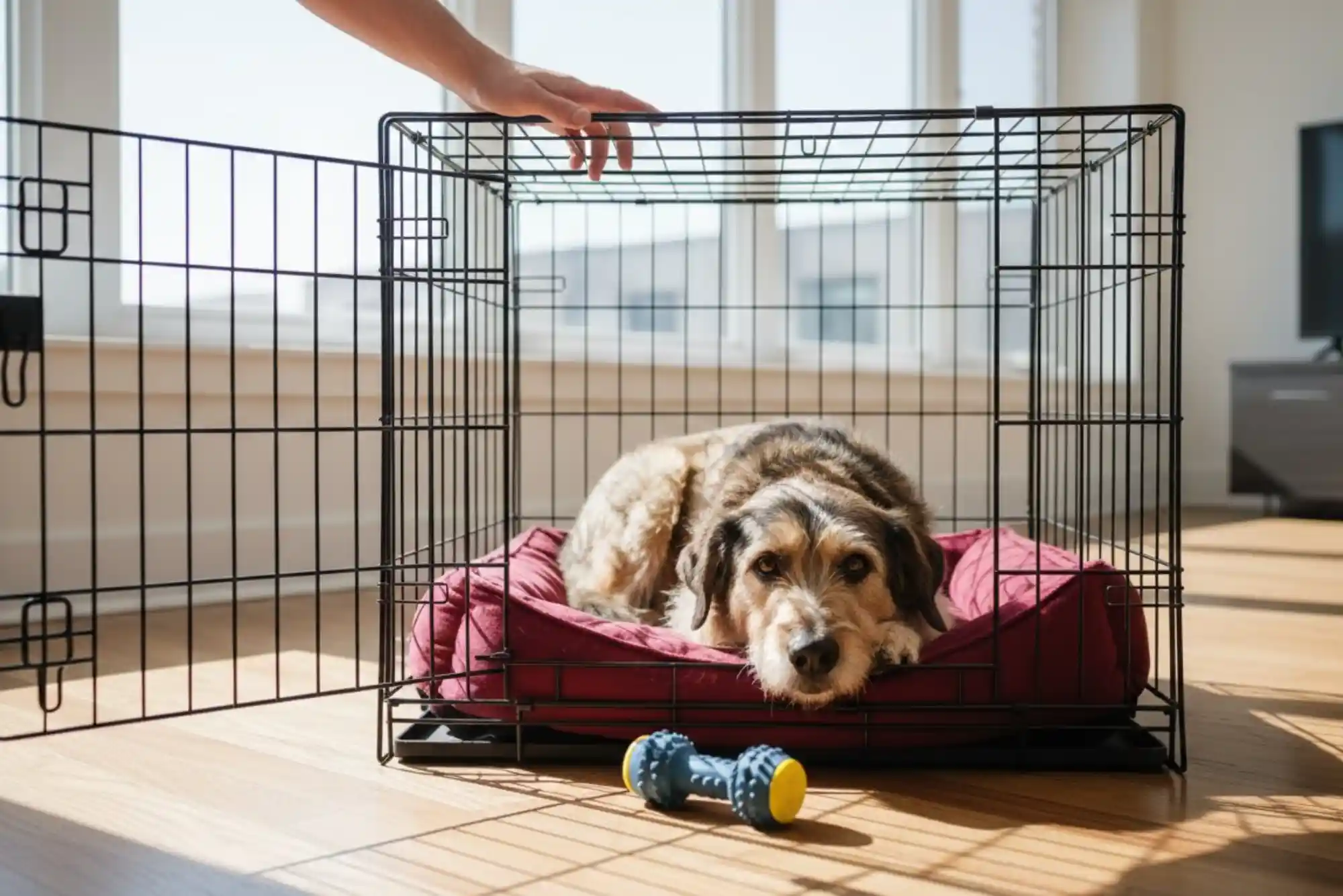
Introduction
Crate training an older rescue dog can feel completely different from teaching a confident puppy. A rescue may arrive with an unknown history, fear of confinement, separation-related distress, or phobias triggered by sounds, rooms, people, or previous experiences. That does not mean successful crate training is impossible. It means the process needs to be slower, more predictable, and centered on trust.
When you crate train an older rescue dog, the goal should not simply be getting the door closed. The real goal is teaching your dog that the crate is a safe place where nothing frightening happens. Older dogs can learn new routines at any age, although dogs with previous negative crate experiences may need considerably more time.
The most important rule is simple: never use the crate to force an anxious dog to “get over” fear. If confinement causes genuine panic, increasing crate time can make the problem worse rather than better.
Why Crate Training an Older Rescue Dog Requires Patience
An older rescue dog has already developed habits and associations before arriving at your home. You may not know whether the dog was previously crated comfortably, left alone for long periods, punished inside a kennel, or confined in stressful circumstances.
That history matters because dogs learn through associations. If your dog sees a crate and immediately freezes, backs away, pants, trembles, or tries to escape, the crate itself may have become a fear trigger.
At the same time, separation anxiety is a separate issue from ordinary crate resistance. A dog may dislike the crate but relax when you remain nearby. Another dog may be perfectly comfortable in the crate while you are home but panic as soon as you leave.

Understanding which problem you are dealing with helps you choose the right training strategy.
Understand the Difference Between Crate Fear and Separation Anxiety
Before you crate train an older rescue dog, watch what happens at different stages.
If your dog becomes nervous as soon as they see the crate, you may be dealing with crate-related fear. If they happily enter the crate but panic when the door closes, confinement may be the trigger.
If the dog remains relaxed while you are beside the crate but becomes distressed when you walk toward the door, separation may be the bigger problem.
True separation anxiety can involve intense distress when a particular person leaves. Signs can include persistent vocalization, pacing, destructive escape attempts, excessive salivation, house-soiling, or self-injury. Severe cases require a proper behavior plan rather than simply increasing crate time.
Phobias can complicate things further. A dog frightened by thunderstorms, fireworks, traffic, unfamiliar noises, or certain household sounds may become more distressed when confined because they cannot move away from the trigger.
Create a Safe Crate Environment First
The crate should initially become part of the furniture rather than a place where the dog is suddenly locked away.
Choose a crate that allows your dog to stand, turn around, lie down comfortably, and change position without difficulty. Older dogs may also need additional consideration for joint comfort, mobility problems, or age-related health issues.
Put the crate in a quiet but familiar part of the home. Avoid placing it somewhere your dog feels isolated from everyone. At the same time, avoid an extremely busy location where constant activity prevents relaxation.
Leave the door open.
Do not push your dog inside. Do not drag them toward it. Do not repeatedly command them to enter.
Instead, allow curiosity to do some of the work.
You can place a few valuable treats near the entrance and eventually farther inside. If your dog only takes the treat and backs away, that is still progress. You are teaching the dog that approaching the crate predicts something positive.
Let Your Dog Choose to Enter
The early stage of crate training should be almost boring.
Your dog might walk past the crate several times before showing interest. That is fine.
Reward small signs of curiosity. Looking at the crate, sniffing it, standing near it, placing one paw inside, and eventually walking all the way in can each be meaningful steps.
Once your dog willingly enters, give the reward while keeping the door open.
Do not immediately shut the door.
That mistake is common because owners naturally want to move to the next stage quickly. However, if entering the crate suddenly predicts confinement, your dog may stop entering altogether.
For a fearful rescue, voluntary entry is more valuable than fast progress.
Build Positive Associations With Food and Enrichment
Food can make crate training easier because it gives your dog a reason to spend time near the crate without feeling pressured.
Begin by feeding meals near the crate. When your dog is comfortable, gradually move the bowl closer to the entrance. Eventually, you can place the meal just inside.
If your dog stops eating, back up.
A dog refusing a favorite food can be an important indication that the training step is creating too much stress. Training cannot be effective when the dog is already overwhelmed.
You can also use a safe food toy or long-lasting enrichment item that your dog already enjoys. The purpose is not to distract a panicking dog. Instead, it is to build a history in which relaxing inside the crate predicts pleasant experiences.
Introduce the Crate Door in Tiny Steps
Once your dog regularly enters the crate and remains relaxed, you can begin working with the door.
Start by moving the door slightly while your dog is inside. Open it again immediately.
Repeat this calmly.
Then close it for a second or two while you remain directly beside the crate. Open it before your dog becomes distressed and reward calm behavior.
Over subsequent sessions, gradually increase the duration.
There is no universal number of seconds that every dog should tolerate. One rescue may comfortably handle 20 seconds while another needs to practice for several days at two or three seconds.
The correct pace is the pace at which your dog remains emotionally comfortable.
If whining, scratching, panting, trembling, pacing, or frantic behavior begins, consider that information rather than stubbornness. Your previous step was probably too difficult.
Teach Independence Before Practicing Long Departures
When you crate train an older rescue dog, it is tempting to combine crate confinement and separation training immediately. For a fearful dog, that can be too much.
First teach the dog that being in the crate while you are nearby is safe.
Sit beside the crate and read, work, or watch television. Your dog can learn that nothing exciting or threatening happens when the door is closed.
Then begin moving around the room.
Walk a few steps away and return.
Walk toward another room and return.
Eventually disappear from sight for a very short period.
The important principle behind systematic desensitization is to expose the dog to the frightening situation at an intensity low enough that they can remain calm.
If your dog panics when you disappear for five seconds, practicing five-minute absences will not teach independence. It may instead rehearse the very panic you are trying to reduce.
Practice Departure Cues Separately
Dogs with separation fears often notice your routine before you actually leave.
Keys jingling, shoes going on, a particular jacket, a work bag being picked up, or walking toward the front door can become predictors of separation.
You can reduce the emotional significance of these signals by practicing them without leaving.
Pick up your keys, then sit down.
Put on your shoes, then make tea.
Walk toward the door, then return to the room.
This helps break the automatic connection between a departure cue and an extended absence.
When you eventually leave during training, keep the departure calm and uneventful. Avoid long emotional goodbyes that may increase anticipation.
How to Handle Phobias During Crate Training
Phobias require special consideration because the crate cannot be expected to eliminate the underlying fear.
Suppose your rescue dog is terrified of thunderstorms. If you suddenly place the dog in a closed crate during a storm, the dog may associate the crate with an extremely frightening experience.
Instead, establish the crate as a comfortable place during ordinary, quiet periods.
For dogs with noise phobias, background sound may sometimes help reduce environmental stimulation, but it should not replace appropriate behavioral or veterinary care.
The same principle applies to fireworks, construction noise, vacuum cleaners, traffic sounds, or other triggers. Train when the dog is below their fear threshold rather than deliberately exposing them to overwhelming situations.
Watch for Signs That You Are Moving Too Fast
Successful crate training does not mean forcing a dog to remain quiet at any cost.
Pay attention to body language.
A dog that briefly looks concerned but quickly relaxes may simply need a smaller training step. A dog that is panting heavily, drooling, trembling, repeatedly attempting to escape, refusing valuable food, or injuring themselves is showing a much more serious level of distress.
If panic appears, stop the difficult exercise and return to an easier stage.
Do not punish barking, scratching, growling, or fear responses. Punishment can damage trust and make the crate even more frightening.
Never Use the Crate as Punishment
An older rescue needs predictability.
If the crate is used when the dog misbehaves, it becomes associated with consequences rather than security. Instead, the crate should consistently predict rest, food, quiet time, and other positive experiences.
It is also important not to use a crate as a substitute for addressing severe separation anxiety. A crate may provide a safe resting area for some dogs, but it is not a cure for separation anxiety. In some dogs, confinement actually intensifies panic and creates a serious escape-injury risk.
Know When Professional Help Is Necessary
Some rescue dogs need more than a standard crate-training plan.
Speak with your veterinarian if your older dog develops sudden anxiety, nighttime restlessness, new house-soiling, unusual vocalization, or significant changes in behavior. Older dogs can have medical or age-related issues that influence behavior, and training should not be used to overlook those possibilities.
A qualified veterinary behaviorist or experienced reward-based behavior professional can also help when fear is severe.
Professional support is especially important if your dog has attempted to break out of the crate, injured their teeth or paws, shows intense panic when left alone, or cannot remain calm even during very small training steps.
For severe separation anxiety, medication may sometimes form part of a veterinarian-guided treatment plan alongside behavior modification. The purpose is not to sedate the dog into tolerating fear. It is to help reduce overwhelming anxiety enough that learning can become possible.
How Long Does Crate Training an Older Rescue Dog Take?
There is no reliable universal timetable.
Some older dogs become comfortable with a crate within a few weeks. Others need considerably longer, particularly when they have previous trauma, phobias, or severe anxiety. Published guidance also emphasizes that the individual dog’s history and associations can substantially affect the timeline.
Think in terms of behavior rather than deadlines.
Your dog is ready to progress when they can comfortably repeat the current step. If they begin showing fear, go backward.
A slower training plan that builds genuine confidence is more valuable than a fast plan that creates another negative association.
Common Mistakes That Can Set Training Back
One of the biggest mistakes is shutting the door for too long too soon. Another is forcing a reluctant dog inside because the owner assumes resistance means stubbornness.
Ignoring obvious panic is another serious problem. A fearful dog is not necessarily “being dramatic.” Their nervous system may genuinely be overwhelmed.
Owners can also make progress harder by practicing only when they need to leave the house. Instead, make the crate part of normal life. Your dog should sometimes relax inside while you are sitting nearby, working, watching television, or moving around the home.
Finally, do not compare your rescue dog with another dog’s training timeline. Rescue dogs have different histories, temperaments, and thresholds.
Build Trust Before Duration
Learning how to crate train an older rescue dog with separation fears and phobias is ultimately an exercise in building trust. The crate should become a place your dog understands, not a place they fear.
Start with voluntary entry. Build positive associations. Keep the door open until your dog is comfortable. Introduce confinement in tiny increments, then gradually add distance and separation. Most importantly, pay attention to your dog’s emotional state throughout the process.
If your dog experiences genuine panic, severe separation anxiety, or dangerous escape behavior, do not try to solve everything by increasing crate time. Work with your veterinarian or a qualified behavior professional to create a safer plan.
With patience, consistency, and compassionate training, many older rescue dogs can learn that a crate is simply a quiet, predictable place to rest.
FAQs
Can you crate train a dog with separation anxiety?
Sometimes, but it depends on the individual dog. If the dog already views the crate as a safe place, it may support a broader separation-training plan. If confinement causes panic, however, forcing crate time can make the problem worse. Separation anxiety should be addressed separately with gradual behavior modification and, when necessary, professional veterinary or behavioral support.
Is it ever too late to crate train a dog?
No. Dogs can learn crate skills at different ages, including adulthood and senior years. Older dogs may need more patience, particularly when they have established fears or negative associations with confinement.
How long does it take to crate train an older dog?
There is no fixed timeframe. Some dogs become comfortable within a few weeks, while fearful rescue dogs can require substantially longer. The dog’s history, temperament, previous crate experiences, and anxiety level all influence progress.
Should I ignore my dog crying in the crate?
Not automatically. Mild, brief vocalization can be different from genuine distress. If your dog is showing escalating panic, heavy panting, frantic escape attempts, trembling, or self-injury, do not simply wait for them to “cry it out.” Reduce the difficulty and reassess whether the crate is appropriate for that dog.
Can crate training make separation anxiety worse?
Yes, particularly when an already anxious dog is forcibly confined and left to panic. A crate is not an automatic treatment for separation anxiety. For some dogs it provides security; for others it increases distress. The dog’s response should determine whether crate training is appropriate.
What is the fastest way to crate train an older dog?
The fastest sustainable approach is usually not to rush. Use positive reinforcement, short sessions, voluntary entry, and gradual increases in duration. Moving too quickly can create fear and cause setbacks, making the overall process take longer.