Introduction
Choosing the right tactical dog harness with handle is about much more than finding a rugged-looking vest. Large breeds and working dogs need equipment that provides reliable control, distributes leash pressure properly, and stays comfortable during extended use. A well-designed harness can also give the handler a secure point for close control when a dog needs to be guided through crowds, rough terrain, training exercises, or challenging situations.
The market is full of products described as “tactical,” but construction quality varies considerably. Some focus on MOLLE-style storage and appearance, while others are designed around fit, stability, and working-dog handling. For large breeds and service dogs, those practical differences matter.
Current harness research shows that useful features include reinforced handles, multiple adjustment points, durable webbing, dependable attachment hardware, and sizing based on actual chest girth rather than simply choosing “Large.”
What Makes a Tactical Dog Harness With Handle Different?
A tactical dog harness with handle is generally designed to provide more control and utility than a basic walking harness. The defining feature is the reinforced grab handle positioned on the upper portion of the harness.
For a large dog, that handle can be useful when you need to keep the dog close without reaching for the collar. It can also make it easier to guide a dog over uneven ground or stabilize the dog briefly during training.
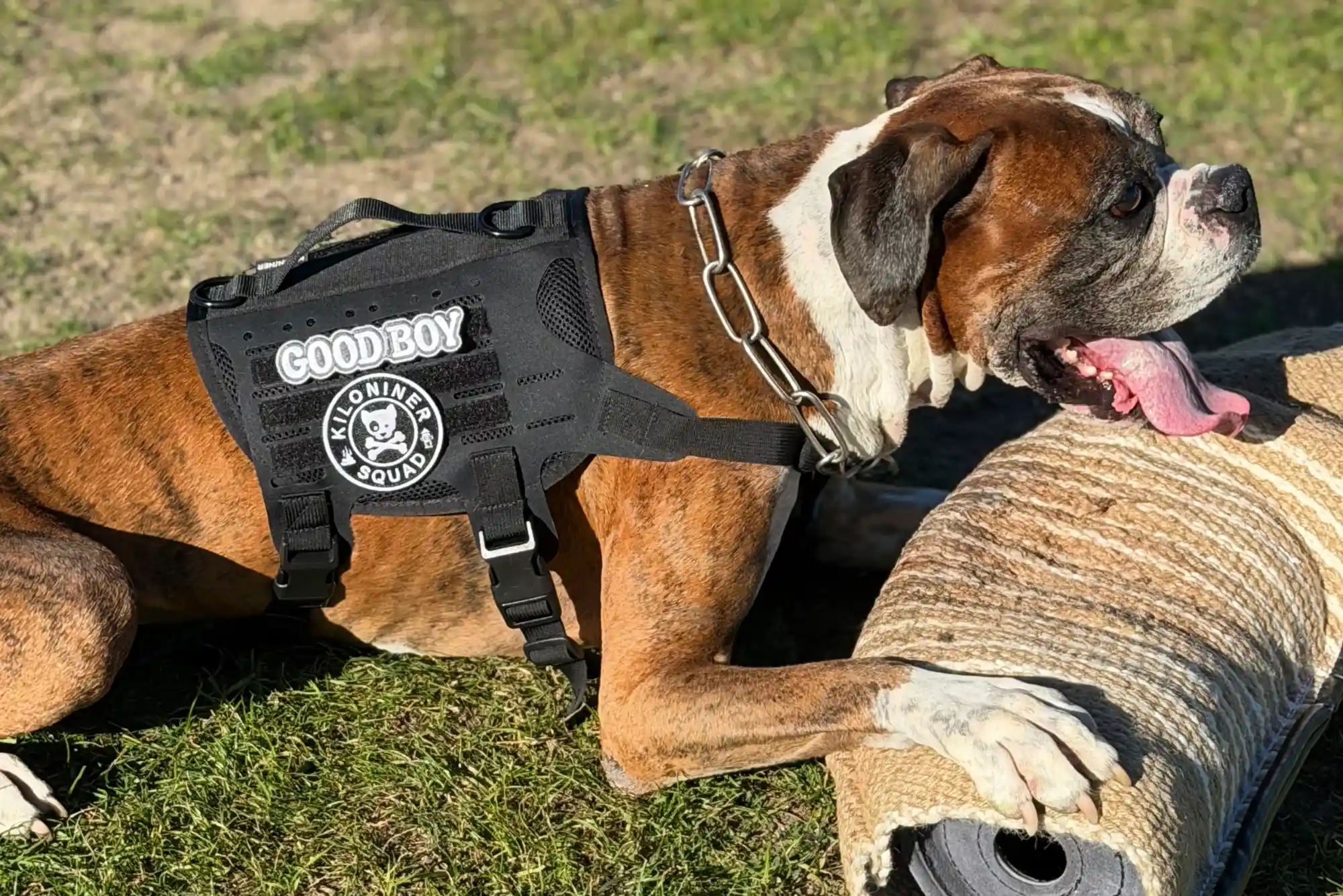
Tactical harnesses often use durable nylon, reinforced stitching, metal or heavy-duty polymer hardware, leash attachment points, and hook-and-loop areas. Some also include MOLLE-style webbing for attaching lightweight accessories.

However, “tactical” does not automatically mean stronger or safer. A product should be judged by its actual construction, fit, hardware, and intended use rather than military-style appearance.
Why Large Breeds Need a Properly Fitted Harness
Large dogs generate considerably more force when they pull, change direction, or become excited. German Shepherds, Rottweilers, Dobermans, Belgian Malinois, and other muscular breeds can quickly expose weaknesses in poorly fitted equipment.
A harness that is too loose may shift sideways or allow the dog to back out. One that is too tight can rub the skin, restrict movement, or create uncomfortable pressure around the chest and shoulders.
The most important measurement is usually the dog’s chest or girth circumference. Measure around the widest part of the rib cage, then compare that measurement with the manufacturer’s sizing chart. For example, Ruffwear’s Web Master currently ranges from 13 to 42 inches in girth, with the largest L/XL size covering 32–42 inches.
Never assume that every brand’s “XL” means the same thing.
Look Beyond Weight Ratings
Weight can help narrow your options, but body shape matters just as much. Two dogs weighing 80 pounds can have completely different chest widths, neck sizes, and body proportions.
Deep-chested dogs may require more adjustment around the shoulders and belly. Dogs with thick coats can also need slightly different positioning than short-coated dogs.
A good fit should feel secure without squeezing the rib cage or interfering with the dog’s natural stride.
Best Tactical Dog Harness With Handle Features to Look For
The best tactical dog harness with handle should combine control, comfort, and durability instead of concentrating on one feature.
Reinforced Handle
The handle is one of the main reasons to choose a tactical-style harness. It should be securely integrated into the harness rather than attached to a thin piece of decorative webbing.
A reinforced handle gives the handler a practical grip for short periods of close control. Ruffwear’s Web Master, for example, uses a reinforced handle designed for lift and assist support on technical terrain.
It is important, however, not to assume that every handle is designed for lifting a dog’s entire body weight. If a manufacturer does not publish a lifting or load rating, treat the handle primarily as a control point.
Strong Leash Attachment Points
The leash attachment point should be appropriate for the way the harness will be used.
A rear attachment works well for ordinary walking and hiking. A front attachment can provide additional control for dogs that pull, although leash-training should not depend on equipment alone.
Some working harnesses provide both front and rear attachment points. This gives handlers more flexibility when moving between training and everyday walking.
Durable Webbing and Stitching
The strongest-looking fabric means little if the stitching around the attachment points is weak.
Pay particular attention to areas where the handle, D-rings, and straps connect to the main body. Reinforced stitching and multiple layers of webbing are useful indicators of a harness designed for demanding use.
Comfortable Interior Padding
Large dogs may wear their harness for hours. Durable materials therefore need to be balanced with comfort.
Padding around pressure points can reduce rubbing, while breathable sections can help during warmer conditions. A harness should allow the dog’s shoulders to move naturally rather than restricting the front legs.
Tactical Harness Options Worth Considering
Several current harness designs illustrate the different approaches available.
The Ruffwear Web Master is a useful example for handlers who prioritize secure fit and controlled movement over a military-style MOLLE platform. Ruffwear describes it as having been used by avalanche rescue teams, service dog handlers, and conservation teams. Its neck buckle also allows the harness to be put on without pulling it over a dog’s head.
For owners specifically looking for tactical construction, current market comparisons include products from OneTigris, Leader K9, ICEFANG, rabbitgoo, and other manufacturers. Their designs vary in materials, buckle construction, attachment points, handle configuration, and available sizes.
OneTigris models, for example, commonly emphasize 1000D nylon, MOLLE-style webbing, reinforced handles, and multiple attachment points. Some current models publish specific hardware load ratings, which is useful because many tactical harnesses make strength claims without giving measurable specifications.
Leader K9’s current tactical harness is another example aimed at large and powerful breeds, with published sizing extending into very large dogs and a combination of metal buckles, front and rear attachment points, and MOLLE-style panels.
The important lesson is that there is no universal “best” design for every dog. A hiking dog, mobility-assistance dog, obedience dog, and working K9 can have very different equipment requirements.
Is a Tactical Dog Harness Good for Service Dogs?
A tactical dog harness with handle can be useful for some service dogs, particularly when the handler needs a stable grip or wants a harness that can accommodate identification patches.
However, the harness itself does not make a dog a service animal.
In the United States, the Americans with Disabilities Act does not require a service dog to wear a vest, special harness, or identification patch. The ADA defines service animals based on training to perform work or tasks directly related to a person’s disability.
That distinction is important because many products are marketed as “service dog vests.” Wearing one does not independently establish service-animal status.
A service dog harness should therefore be selected primarily around the dog’s actual work and the handler’s needs.
When a Handle Can Be Useful
A handle can provide a convenient point for close guidance, especially in crowded environments or when a handler needs to keep the dog positioned nearby.
For mobility-related work, however, handlers should be particularly careful. A standard grab handle is not automatically designed to support a person’s body weight. If a dog is trained for substantial bracing or mobility assistance, the equipment should be specifically designed and approved for that purpose rather than assuming a tactical handle can safely perform it.
MOLLE Panels: Useful or Mostly Cosmetic?
MOLLE-style webbing is one of the features that gives tactical harnesses their distinctive appearance.
Its practical purpose is modular attachment. Depending on the harness, owners may use it for lightweight pouches, identification accessories, lights, or other equipment.
But MOLLE should not be the first purchasing criterion for a large dog. A harness with excellent MOLLE panels but poor fit is still a poor harness.
Also consider how much weight you intend to attach. Adding several pouches can make a harness heavier and may change how it sits on the dog’s body.
For a service dog that already carries essential working equipment, keeping the configuration lightweight can be more useful than filling every available attachment point.
How to Fit a Tactical Dog Harness With Handle
Start by measuring the dog’s girth with a soft measuring tape. Place the tape around the widest part of the rib cage, generally just behind the front legs.
Compare the measurement with the exact manufacturer’s chart. Do not rely on breed name or body weight alone.
Once the harness is on, check that the straps sit securely without digging into the skin. The dog should be able to walk, sit, turn, and lie down naturally.
Run your fingers underneath the straps to check the fit. You want secure contact without excessive compression.
The handle should remain centered along the dog’s back. If the harness rotates significantly when the leash is attached, the fit or adjustment may need to be changed.
Recheck the fit periodically. Straps can loosen during active use, and a dog’s body can change with age, weight, coat condition, or muscle development.
Common Mistakes When Buying a Tactical Dog Harness
One of the biggest mistakes is choosing a harness because it looks rugged in photographs. Heavy fabric and camouflage patterns do not necessarily indicate quality.
Another common mistake is buying based on a generic size label. A “Large” from one manufacturer may fit a completely different dog than a “Large” from another.
Some owners also assume that a padded handle automatically means it can support the dog’s full body weight. Unless the manufacturer provides a suitable rating and intended use, the handle should be treated as a control handle rather than a lifting device.
Finally, avoid adding unnecessary equipment. Extra pouches, patches, lights, and accessories increase weight. The best working setup is usually the one that provides what the dog and handler actually need without unnecessary bulk.
How to Choose the Right Harness for Your Dog’s Job
Think about what the dog actually does every day.
For everyday walking, a comfortable harness with a reliable handle may be enough. For hiking, you may want a secure three-point design and a reinforced grip. For training, front and rear attachment options can provide greater flexibility.
For service work, comfort and stable positioning are particularly important because the dog may wear the harness for long periods. For search-and-rescue or other demanding working environments, material quality, hardware construction, adjustment range, and field durability become more important.
The best tactical dog harness with handle is therefore not necessarily the heaviest one. It is the one whose construction matches the dog’s size, activity, environment, and handling requirements.
Safety Tips for Large and Working Dogs
A harness should never replace training. Even excellent equipment cannot compensate for poor leash skills or an improperly controlled dog.
Inspect the stitching, buckles, D-rings, straps, and handle regularly. Look for fraying, cracked hardware, stretched webbing, or loose stitching.
Introduce a new harness gradually. Allow the dog to wear it indoors for short periods before moving into longer walks or demanding activities.
Watch for rubbing around the armpits and chest. If the dog repeatedly scratches, avoids movement, or shows discomfort, reassess the fit.
For dogs involved in professional work, consult the relevant trainer, veterinary professional, or working-dog organization when equipment is being used for specialized tasks.
FAQs
What is the best tactical dog harness with handle for a large dog?
The right choice depends on the dog’s girth, body shape, activity, and handling requirements. Look for a reinforced handle, reliable attachment hardware, adequate adjustment, durable stitching, and a published size range that actually fits your dog.
Are tactical harnesses good for large dogs?
They can be. Large dogs often benefit from harnesses that provide better control and distribute leash pressure across the chest rather than concentrating force around the neck. The harness must still be correctly fitted and appropriate for the dog’s activity.
Can you lift a dog by a tactical harness handle?
Not necessarily. A grab handle is primarily intended for control unless the manufacturer specifically states that it is designed and rated for lifting or assistance. Never assume a handle can safely support the dog’s full weight.
Do service dogs need a special harness or vest?
Under the U.S. ADA, service dogs are not required to wear a vest, special harness, or identification patch. The dog must meet the legal definition of a service animal and remain under the handler’s control, subject to the applicable rules.
What size tactical harness should I get for my dog?
Measure the dog’s chest girth and compare it with the manufacturer’s specific sizing chart. Do not select a size based only on breed, weight, or labels such as Medium or Large.
Are tactical dog harnesses suitable for service dog work?
Some can be suitable, particularly when the design provides comfortable long-term wear, stable positioning, and useful control features. The important consideration is whether the harness supports the dog’s actual tasks without restricting movement or creating discomfort.
A well-designed tactical dog harness with handle can be valuable equipment for large breeds, active dogs, working dogs, and some service-dog handlers. The most important features are not simply a rugged appearance or MOLLE webbing. Fit, reinforced construction, dependable hardware, comfortable padding, useful attachment points, and an appropriate handle should guide the decision.